Porsche
Consistent development makes the Porsche 963 a serial winner
Back-to-back dominance continues
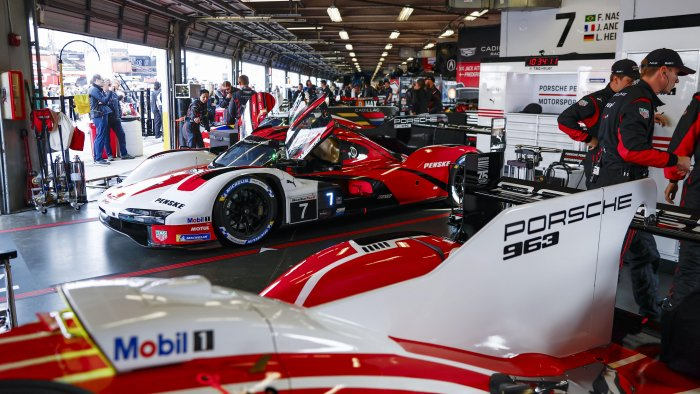
Porsche Penske Motorsport heads into the first sprint race of the 2026 IMSA WeatherTech SportsCar Championship season — scheduled for the streets of Long Beach on April 17–18 — with an unblemished record. The Porsche 963 has taken overall victory at the 24 Hours of Daytona for the third year running and followed that with a one-two result at the 12 Hours of Sebring, placing the team, along with factory drivers Felipe Nasr, Julien Andlauer and Laurin Heinrich, at the top of every IMSA standings column.
Seven further races remain on the calendar, ranging in duration from 100 minutes to ten hours. Each presents a markedly different challenge, yet Porsche Penske Motorsport enters them all as title defender, having swept every IMSA championship in both 2024 and 2025.
A three-stage development plan
The 963, which produces up to 707 hp (520 kW), has been in continuous development since its rollout at Weissach in January 2022. Progress has been structured across three deliberate phases. During the winter of 2023, the engineering team concentrated on durability improvements ahead of the 2024 campaign. For 2025, the focus shifted to chassis optimisation, including kinematics. At the start of the current season, aerodynamic development became the primary area of work.
This phased approach has been shaped by a strict regulatory constraint. Under the current LMDh homologation cycle, which runs through the end of 2027, manufacturers competing in both IMSA and the FIA World Endurance Championship are permitted only five development jokers. With resources so tightly rationed, every update decision has demanded precision. Technical Director for the LMDh project Stefan Moser described agreeing on a development roadmap early and implementing it consistently as central to the results achieved so far.
Director of Factory Motorsport LMDh Urs Kuratle noted that the limited joker allocation forces the team to identify where the greatest potential for improvement lies, with driver feedback playing a critical role in that identification process.
Factory drivers confirm the gains
Reigning IMSA champion Matt Campbell described the gap between the original 2023-specification car and the current 963 as feeling like two completely different vehicles. He traced the progress chronologically: reliability came first, followed by advances in kinematics, and most recently aerodynamics. He also highlighted ongoing refinements to the car's various control systems, which he said have had a direct impact on braking behaviour, traction and drivetrain power management.
Julien Andlauer, who was at the wheel of the number 7 car for both Daytona and Sebring victories, pointed specifically to the Sebring result as a moment where the latest developments were clearly felt. He described the 963 as notably more pleasant to drive, with better tyre utilisation and significantly improved predictability in fast sections and over kerbs and bumps — characteristics he expects to prove valuable at circuits such as Watkins Glen and Road Atlanta later in the season.
More development still to come
Despite the unbroken run of success, the Weissach team has no intention of pausing its development work. Moser emphasised that the engineers maintain a purely engineering perspective rather than dwelling on results, and that the desire to push physical limits remains the driving motivation. He drew a parallel with the Porsche 911, which the company has developed continuously for more than 60 years, to illustrate the team's philosophy toward the 963.
Kuratle confirmed that at least one development joker remains in reserve, and that careful consideration is already being given to how it can best be deployed for the 2027 season. He added that the Weissach team already has ideas in development — a signal that the 963's evolution is far from complete as it pursues a third consecutive clean sweep of IMSA titles.
Source: Porsche Newsroom.