Lexus and MSCHF Twisted Two Electrified Vehicles Into Impossible Sculptures for New York's Armory Week
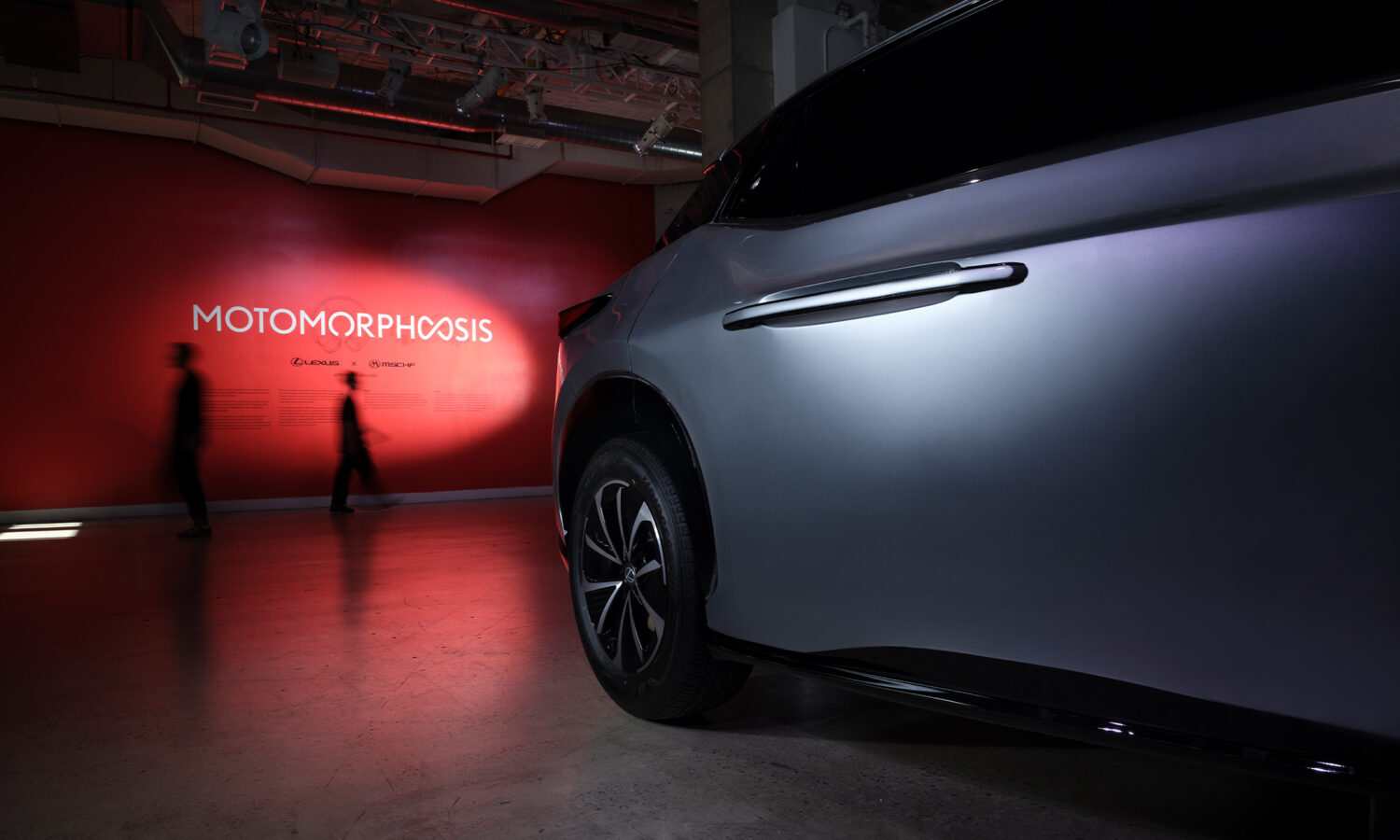
The Brooklyn-based conceptual collective bent and looped an RZ 450e and an RX 450h+ into physical forms that look more like digital glitches than automobiles — and viewers kept trying to open the doors anyway.
From toothbrushes to toasters, electricity powers the everyday objects that fade into the background of modern life. But Lexus began a recent creative project with a different kind of question: what if electricity could make people feel the way art does? That question, according to the Lexus Pressroom, became the seed of MOTOMORPHOSIS, a collaborative exhibition staged during New York's Armory Week with Brooklyn-based conceptual collective MSCHF.
Rather than treating the vehicles as finished products, Lexus invited MSCHF to use two of its electrified models as raw material. The result, as described by the Lexus Pressroom, was a pair of sculptures that registered as simultaneously familiar and physically impossible — forms that blurred the boundary between consumer luxury object and pure sculptural statement.
The first piece, Circle Car, was built from a Lexus RZ 450e and bent into a continuous loop, as if the vehicle had been caught in perpetual motion with no beginning and no end. The second, Twisted Car, took an RX 450h+ and pulled it into a dramatic spiral, giving the impression of a machine caught mid-transformation — somewhere between the physical and the digital. Both sculptures were displayed alongside their unmodified source vehicles, a curatorial decision that put the process of reinterpretation visibly on the table.
MSCHF's Chief Creative Officer Kevin Wiesner spoke with the Lexus Pressroom about the philosophy and mechanics behind the project. Distortion, he explained, sits at the intersection of the deeply familiar and the impossible: shapes that look native to 3D software but appear in the real world create a moment of confusion between the actual and the imaginary. The Lexus Pressroom noted that even installation and transport photographs of the sculptures read as oddly artificial, precisely because the forms are so instantly recognizable as belonging to a computer environment rather than a city street.
Wiesner told the Lexus Pressroom that the conceptual starting point was an inversion of the automotive industry's long tradition of the concept car — a format that often ventures far from production reality as a form of futurecasting. Rather than imagining what a car might become, he said, MSCHF took a purely formalist approach to the object itself. If the concept car exists, the logic went, so must the "form car."
On the question of why Lexus electrified vehicles were the right objects for the project, Wiesner pointed to what he described as a shared philosophical interest in defamiliarization and reinvention, according to the Lexus Pressroom. He framed the collaboration as evidence of a mutual willingness to push an object beyond the expected associations of its category — a process he described as the means by which the sublime is created.
Fabrication, the Lexus Pressroom account makes clear, was neither simple nor straightforward. Each sculpture began with a steel armature, over which thousands of individual pieces were joined to form the outer skin. The finishing, paint, and overcoat processes followed patterns familiar from conventional autobody work, even if the shapes themselves were anything but conventional. Wiesner said the biggest challenge was not any single technique but rather the coordination of multiple existing processes at scale, and the practical requirement that the finished sculptures be transportable for installation.
The exhibition also arrived at a culturally charged moment for the relationship between real and generated imagery. Wiesner acknowledged to the Lexus Pressroom that audiences now routinely assume impossible-looking images are the product of artificial intelligence. He drew a distinction, however, between AI imagery — which he characterized as all surface, without internal logic — and the consistent geometric logic of the transformations used in MOTOMORPHOSIS, which derive from the specific rules of 3D software. That coherence, he suggested, may actually amplify the impact of encountering such forms in physical space.
As for audience reaction, the Lexus Pressroom reported one detail that stood out above the rest: viewers repeatedly and sincerely tried to open the doors of the sculptures. Whether that impulse reflects the power of automotive muscle memory, the quality of the fabrication, or both, the project appears to have landed exactly where its makers intended — in the disorienting gap between what the eye expects and what the mind can accept.
AutoWorld Take
Source: Lexus USA Newsroom