Mercedes-Benz Previews Glass-Embedded Displays and a Software-Controlled 800-Volt Power Converter
Three research-stage technologies — LED displays laminated into windows, a holographic windshield projection system, and a programmable high-voltage converter — show where the automaker's engineers are aiming next, though none are slated for production yet.
Mercedes-Benz has pulled back the curtain on three technologies currently moving through its research and development pipeline, framing each as a potential building block for future vehicles rather than a confirmed product announcement. According to a November 3, 2026 release published by Mercedes-Benz USA media, the technologies span two distinct areas: novel ways to display information on and through vehicle glass, and a new approach to managing high-voltage energy in battery-electric powertrains.
The first concept, which the company refers to as Intelligent Display in Glass, explores embedding LED elements directly into window glass composites. The release describes two LED variants being evaluated for different roles. Mini LEDs, suited to larger surfaces like a rear window, could theoretically present brake lights, hazard warnings, or traffic-related messaging to drivers following behind. Micro LEDs, which offer finer resolution, are being considered for smaller display zones where more detailed animations would be appropriate. A key design goal noted in the release is that the display elements remain nearly invisible when not in use, blending into the glass rather than altering the vehicle's appearance.
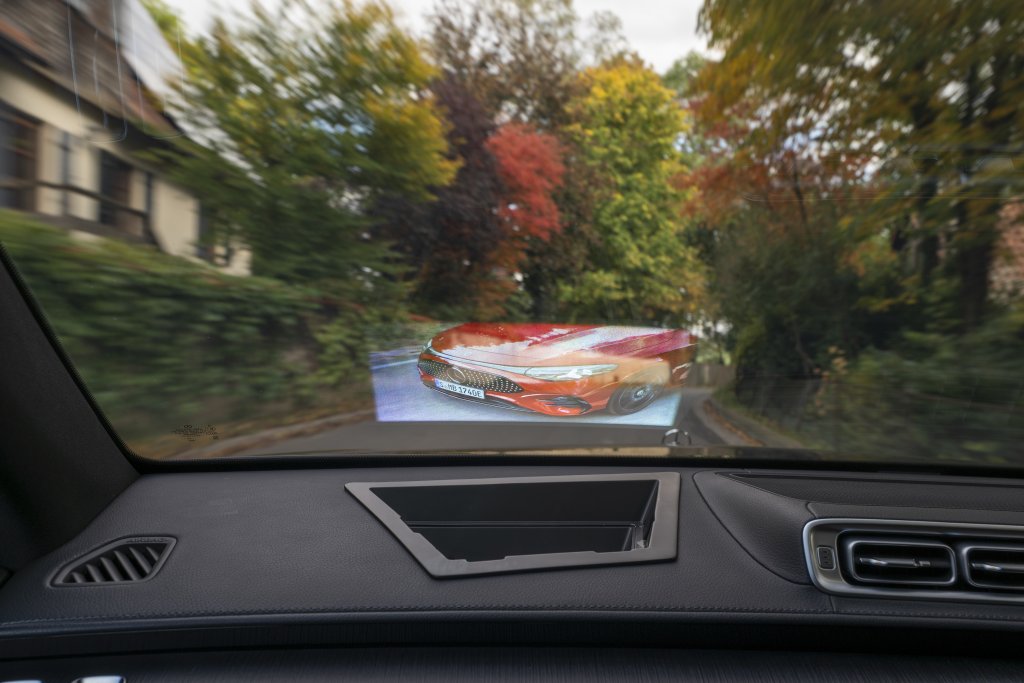
The second display concept takes a different approach by focusing on the windshield rather than other windows. Mercedes-Benz USA media describes a holographic display system in which a projector housed in the instrument panel casts content onto the windshield, where a transparent film embedded in the glass uses what the release calls holographic optical elements — abbreviated HOE — to selectively bounce back specific wavelengths of light. The result, according to the release, is an image that stays legible even under direct sunlight. The system is also designed so that the driver's side and passenger side each see only their own content, since the image is visible only within defined viewing angles. Potential uses listed in the release include navigation guidance, points-of-interest context, video calls, and other driving-relevant information, with the display appearing only on demand rather than being permanently visible.
The third technology being highlighted is the Mercedes-Benz Power Converter, a development-stage device aimed at rethinking how high voltage is generated and distributed in electric vehicles. Rather than relying on the battery's cell-count-driven voltage directly, the system uses programmable micro-converters to individually manage the energy contribution of cells or cell groups, then aggregate those contributions into a stable high-voltage DC output of up to 800 volts regardless of how charged or aged the underlying cells are. The release states the current generation of the Power Converter delivers up to 3 kilowatts of output and supports both AC and DC conversion as well as bidirectional charging functionality.
The broader implication described in the release is architectural flexibility: because the high-voltage output would be shaped by software-controlled electronics rather than fixed by the physical arrangement of cells, future battery and powertrain designs could be more compact and modular. Multiple converters connected in parallel could scale total output up or down to match different vehicle requirements. The release also suggests the technology could eventually consolidate functions now handled by separate hardware units, potentially benefiting both battery-electric vehicles and plug-in hybrid architectures.
Mercedes-Benz USA media explicitly states that all three technologies are pre-production research efforts and do not represent announcements of customer-facing features or confirmed series production applications. The release was issued in Atlanta and ties the announcement to the company's broader "140 Years of Innovation" milestone, which marks 140 years since Carl Benz filed the patent for what is described as the first automobile. No timeline for any of the three technologies entering production, nor any indication of specific vehicle applications or market availability, was included in the release.
AutoWorld Take
Source: Mercedes-Benz USA Media