Mercedes-Benz stages world's first public high-speed side-impact crash test with two moving CLA sedans
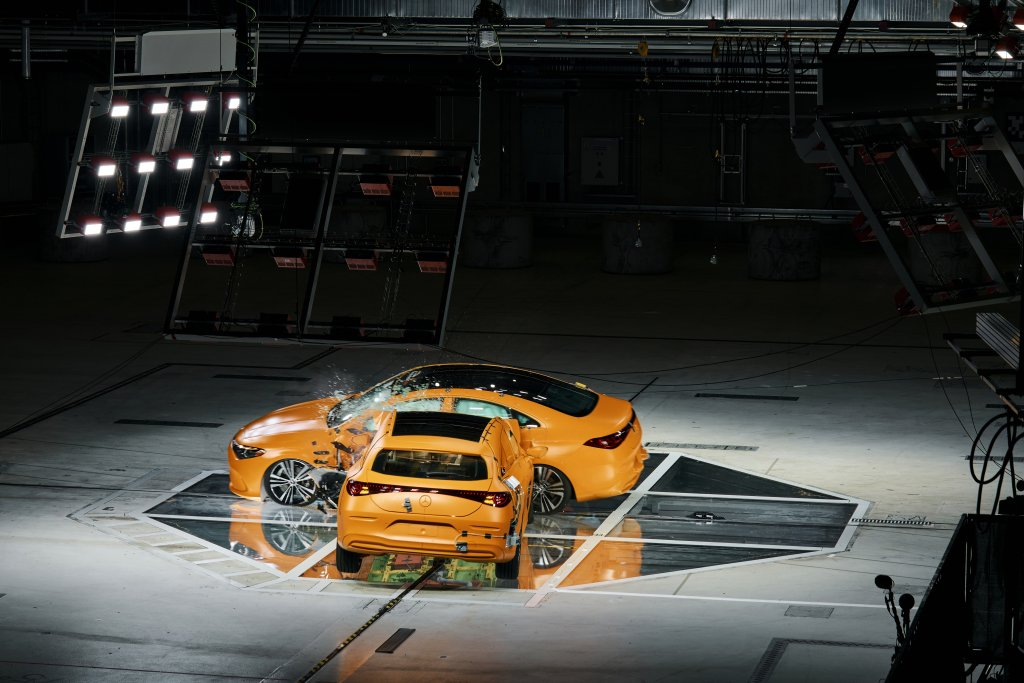
Both vehicles traveling at 35 mph, eight dummies within biomechanical limits, and the electric CLA's high-voltage battery emerged undamaged, according to Mercedes-Benz
Mercedes-Benz has conducted what it describes as the world's first public high-speed side-impact crash test using two production vehicles, with a CLA equipped with an electrified internal combustion engine striking the driver's side of an all-electric CLA. Both cars were traveling at 35 mph and neither was subjected to braking before impact, conditions the automaker says reflect the upper end of real-world junction collision speeds identified through its own accident research.
The test was documented by Mercedes-Benz USA Media and dated October 20, 2026. Each vehicle weighed more than 4,000 pounds, and the scenario was deliberately chosen to stress the most protection-critical areas of the all-electric model: the passenger compartment and the high-voltage battery pack housed in the underbody. Because vehicles have considerably less structural space on their sides to absorb energy than at the front, Mercedes-Benz characterizes side-impact collisions as among the most demanding safety scenarios.
According to Mercedes-Benz, the passenger compartments of both vehicles remained intact after the collision. Readings from all eight crash-test dummies — representing four adults and four children — stayed within the biomechanical limits used by the industry to evaluate occupant protection, and the high-voltage battery came through undamaged. Each dummy instrumented up to 150 measurement points, and Mercedes-Benz says the data confirmed that all safety systems functioned as intended, with results indicating a low risk of serious or life-threatening injury.
The company notes that no regulatory requirement or safety-rating protocol mandates a side-impact test between two moving production vehicles; standard procedures use stationary barriers or specified impact vehicles. Mercedes-Benz framed its choice of two production cars at real-world accident speeds as an expression of what it calls its Real-Life Safety philosophy. The automaker cited its own accident research program, which it says has been running since 1969 and has analyzed approximately 6,000 accidents through research teams in Germany, China, and India.
Before any physical test, Mercedes-Benz says each new model undergoes roughly 15,000 virtual crash simulations, with artificial intelligence used to sharpen prediction accuracy. The company also says it conducts approximately 150 physical crash tests per new model overall, a figure it describes as exceeding typical industry requirements. Mercedes-Benz further notes that around a quarter of accidents resulting in personal injury involve side impacts, a statistic it says underscores the relevance of the chosen test scenario.
AutoWorld Take
Source: Mercedes-Benz USA Media