Porsche Mission S Vision Model Debuts in New York as Preview of Future Design Direction
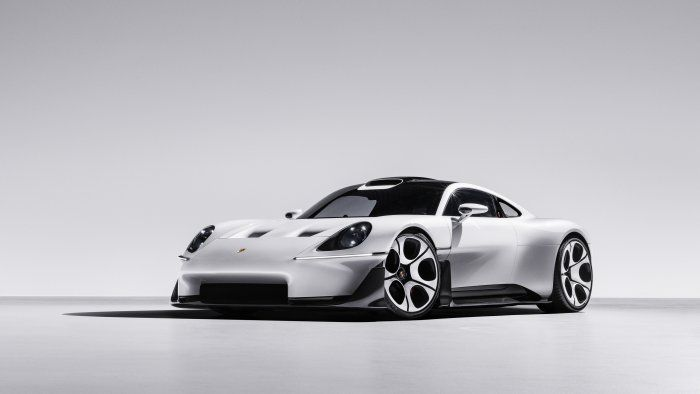
The mid-engined show car signals a new super sports car platform positioned above the 911, with a design language rooted in historic Porsche icons
Porsche has unveiled the Mission S, a vision model the brand says offers a first look at the design identity it intends to carry into its future production lineup. The world premiere took place on a pier in Queens, New York — a location the company chose deliberately, noting that the first photographs of the mid-engined 550 Spyder were taken there in 1953.
The reveal is tied to a strategic initiative Porsche describes as "Sportwagenschmiede 35." According to the Porsche Newsroom, the Mission S is meant to demonstrate an "authentic, consequent, and timeless" design philosophy, and the brand frames the show car not as an isolated styling exercise but as a preview of features that will eventually appear across its future product range.
The Porsche Newsroom reports that the Mission S is conceived around a mid-engine super sports car platform, intended to sit above the 911 in the lineup. Crucially, Porsche describes this as a permanent addition to its customer offering rather than a limited hypercar. No production timeline, pricing, or powertrain specifications are disclosed in the source material.
Exterior design borrows heavily from Porsche's own historical catalog. The Porsche Newsroom describes torpedo fenders and round headlights as nods to the 911, while shut lines merging into light graphics pay homage to the G-model 911 produced from the 1974 through 1989 model years. The flat front references the 911 GT1, the roofline draws from the 959, and a car-in-car rear concept is also derived from the GT1. A single wraparound main line connects the front and rear light signatures. Wheel design takes its cue from the 928's dial design, reinterpreted with lightweight construction as a stated priority. A cooling solution described as reminiscent of the Porsche 917's radiator fan and a fully integrated active rear wing are cited as further functional-design details.
Inside, the Mission S is described by the Porsche Newsroom as a return to core sports car values, with the interior architecture referencing the 550 Spyder and the 356. A five-tube instrument cluster sits behind the steering wheel, featuring a central tachometer with an analogue needle. The Porsche Newsroom notes that this tachometer moves physically closer to the driver depending on the selected driving mode, and that the arrangement of the surrounding instruments also shifts between modes. The ignition key holder is positioned to the left of the steering wheel, consistent with Porsche's longstanding tradition.
Rather than a fixed center display or integrated passenger screen, the concept uses a retractable mount compatible with MagSafe technology that accepts a smartphone for navigation or information display. Classic switches and push-pull control elements are combined with digital interfaces, and a reimagined Sport Chrono element is included. The Porsche Newsroom describes the overall approach as prioritizing driver experience while avoiding unnecessary digital surfaces.
The show car's color palette — described as Firn White Metallic, Light Red Metallic, Black Chrome, and Special Black in the interior — is presented as a reinterpretation of classic Porsche Motorsport colors.
AutoWorld Take
Source: Porsche Newsroom