Volvo Expands NVIDIA Partnership for Future Automated-Driving Technology
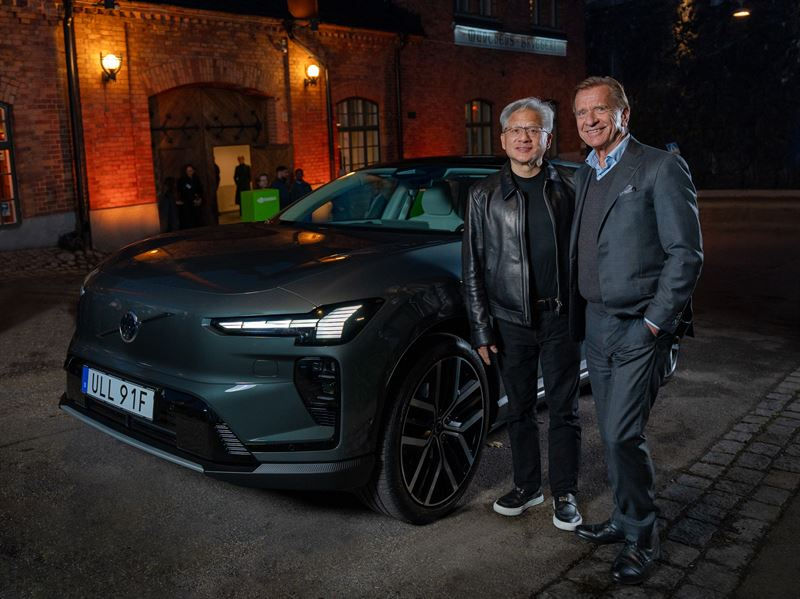
The companies plan a new sensor, computing and software architecture, but identify no U.S. launch date or production model.
Volvo Cars is expanding its partnership with NVIDIA to develop automated-driving technology for a future generation of vehicles. Announced October 15, the agreement builds on a collaboration that Volvo says began in 2017, combining its vehicle-safety engineering with NVIDIA computing and artificial-intelligence systems.
The named technology includes NVIDIA’s Hyperion sensor and compute architecture, Halos OS and Alpamayo Stack driving software. Volvo describes an ambition to handle a broader range of driving environments, from highways and city streets to parking, with progressively greater automation.
Those are future-development goals, not capabilities newly activated in cars already owned by customers. The announcement does not name the production model that will introduce the technology, specify a launch date or confirm U.S. availability. It should not be read as permission for drivers of current Volvo vehicles to stop supervising the road.
Volvo says the first application will appear in a next-generation car within its broader product-development program. Its release emphasizes integrating vehicle-safety knowledge with the sensor, software and computing architecture rather than simply adding a new dashboard feature.
For American readers following Volvo and its U.S.-based technology partner, the news concerns the companies’ development direction. It does not establish a locally orderable equipment package, a price or regulatory approval for automated driving.
The distinction matters because an ambition to introduce more capable automation is different from a demonstrated, commercially available driving system. Buyers will need model-specific specifications, operating limits and local availability details before evaluating what the expanded partnership actually delivers in a production vehicle.
AutoWorld Take
Source: Volvo Cars Media